


gRPC vs REST: When to Use Which Protocol

Ronak Kadhi
June 10, 2026
7MIN READ
gRPC vs REST explained: how Protocol Buffers, HTTP/2, and streaming differ from JSON over HTTP, when to use each, and how to test both.
Your lightweight Client for API debugging
No Login Required
Get Requestly
Requestly Works on Desktop Only
Requestly isn’t available for download on mobile or tablets.
To download it, please open this page on a desktop PC and enter your email to get the link.



Mac app
Lightweight & Privacy-first API Client
- Local Projects
- Organize API into Collections & Environments
- API Tests
- Import from Postman, OpenAPI, etc
Download Now


Chrome extension
Intercept & modify HTTP requests/responses
- Redirect URLs & modify HTTP headers
- Mock API / GraphQL responses
- Insert custom JavaScript scripts
Add To Chrome
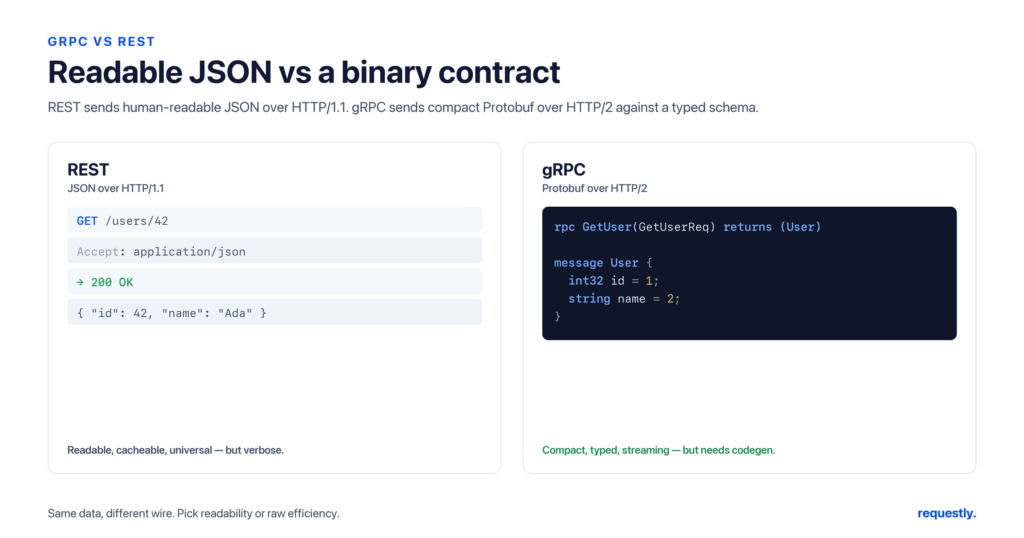
REST and gRPC both let one service talk to another over a network, but they were designed for different worlds. REST grew up on the public web, where requests are human-readable and almost any client — a browser, a curl command, a mobile app — can call your API. gRPC came out of Google’s internal infrastructure, where services call each other thousands of times a second and every millisecond and byte counts.
Choosing the wrong one rarely makes an app impossible; it just makes it slower to build, harder to debug, or more expensive to run than it needed to be. This guide breaks down how the two actually differ, when each is the right call, and how you test them once they are live.
TL;DR
- Use REST for public APIs, browser- and mobile-facing endpoints, CRUD-style resources, and anywhere broad compatibility and easy debugging matter more than raw speed.
- Use gRPC for internal service-to-service calls, low-latency / high-throughput systems, streaming, and polyglot backends that benefit from generated, strongly-typed clients.
- Most real systems use both: gRPC between internal microservices, REST (or a REST gateway) at the public edge where browsers and third parties connect.
What is REST?
REST (Representational State Transfer) is an architectural style, not a framework. You model your domain as resources — /users, /orders/42 — and act on them with HTTP verbs: GET to read, POST to create, PUT/PATCH to update, DELETE to remove. Payloads are almost always JSON, calls are stateless, and the whole thing rides on ordinary HTTP.
Its biggest strength is ubiquity. Every language, browser, proxy, and CDN understands it; every developer can read a JSON response; and you can debug a REST call with nothing more than a URL bar or a one-line curl:
curl https://api.example.com/v1/orders/42 \
  -H "Authorization: Bearer $TOKEN"
What is gRPC?
gRPC is a Remote Procedure Call framework. Instead of resources and verbs, you call methods on a remote service as if they were local functions: GetOrder(OrderRequest) returns an Order. Three things define it (here is a deeper introduction to gRPC if you are new to it):
- Protocol Buffers — you declare your messages and services in a
.protofile, and data travels as a compact binary format instead of text JSON. - HTTP/2 — gRPC runs on HTTP/2, so it gets multiplexed streams over a single connection, header compression, and bidirectional streaming.
- Code generation — that
.protocontract generates typed client and server stubs in Go, Java, Python, and a dozen other languages, so the wire format is never hand-written.
syntax = "proto3";

service OrderService {
  rpc GetOrder (OrderRequest) returns (Order);
  rpc WatchOrders (OrderRequest) returns (stream Order);
}

message OrderRequest {
  int64 order_id = 1;
}

message Order {
  int64 order_id = 1;
  string status = 2;
  double total = 3;
}
gRPC vs REST: the differences that matter
Data format and payload size
REST sends text JSON; gRPC sends binary Protocol Buffers. Protobuf payloads are typically smaller and faster to serialize, which adds up when one request fans out into dozens of internal calls. The trade-off: you can read a JSON response with your eyes, but a protobuf frame is opaque without the .proto to decode it.
Transport: HTTP/1.1 vs HTTP/2
REST is most often served over HTTP/1.1, which handles one in-flight request per connection (no multiplexing, so parallel calls need multiple connections) — though it runs over HTTP/2 as well. gRPC requires HTTP/2 and multiplexes many calls over a single connection, which avoids head-of-line blocking and cuts connection overhead.
Contract and code generation
REST can be documented with OpenAPI/Swagger, but the spec is optional and frequently drifts from the real implementation. gRPC’s .proto file is the contract — it is required, versioned, and generates the client, so server and client cannot silently disagree about types.
Streaming
Plain REST is request/response. gRPC supports four call types — unary, server-streaming, client-streaming, and bidirectional streaming — which makes it a natural fit for live feeds, server-to-server telemetry, or chat backends where you would otherwise reach for WebSockets. (Note: browser clients still can’t consume gRPC streams directly — that limitation is covered below.)
Browser and ecosystem support
This is the deciding factor for many teams. Browsers can call REST directly; they cannot call a gRPC service directly — you need grpc-web plus a proxy such as Envoy to translate. REST is also better understood by caches, API gateways, logging pipelines, and everyday debugging tools.
At a glance
| Dimension | REST | gRPC |
|---|---|---|
| Style | Resources + HTTP verbs | Remote method calls |
| Payload | JSON (text) | Protocol Buffers (binary) |
| Transport | HTTP/1.1 or 2 | HTTP/2 (required) |
| Contract | OpenAPI (optional) | .proto (required) |
| Streaming | Not built in | Unary + server / client / bidirectional |
| Browser calls | Native | Needs grpc-web + proxy |
| Human-readable | Yes | No (binary) |
| Best for | Public / edge APIs | Internal microservices |
When to use REST
- You are building a public API that third parties will consume.
- The client is a browser or mobile app talking directly to the API.
- Your domain is CRUD-shaped — resources you create, read, update, and delete.
- You value simple debugging and broad tooling over maximum throughput.
When to use gRPC
- Internal service-to-service traffic inside your own infrastructure.
- Low latency and high throughput matter — many calls per second on a tight budget.
- You need streaming in one or both directions.
- You run a polyglot backend and want generated, type-safe clients across languages.
You don’t have to choose just one
The most common production pattern is to use both: gRPC for the chatty internal calls between microservices, and REST at the public edge where browsers, mobile apps, and partners connect. Tooling such as grpc-gateway can even transcode a single .proto into both a gRPC service and a REST/JSON endpoint, so you maintain one contract and expose two interfaces.
How to test REST and gRPC
Testing REST
REST is the easy case: any API client can send the request, and you assert on the status code and JSON body. In Requestly you send the request and add a post-response test:
// Post-response script
rq.test("status is 200", function () {
  rq.expect(rq.response.code).to.equal(200);
});

rq.test("order is paid", function () {
  var body = rq.response.json();
  rq.expect(body.status).to.equal("paid");
});
Because REST is just HTTP, you can also import the request from a curl command or an OpenAPI spec and have a runnable collection in seconds.
Testing a REST API? Requestly sends the request, runs rq.test() assertions on the response, and imports straight from cURL or an OpenAPI spec — free, local-first, no login required. Explore the API client →
Testing gRPC
gRPC needs a client that understands Protocol Buffers and HTTP/2. Today that usually means grpcurl, a gRPC-aware GUI, or reflection-enabled tooling:
grpcurl -d '{"order_id": 42}' \
  api.example.com:443 OrderService/GetOrder
Requestly currently focuses on REST, GraphQL, and SOAP; native gRPC support is on our roadmap. If your architecture is gRPC-internal with a REST edge, you can test the public REST surface in Requestly today and reach for a gRPC-specific tool for the internal methods.
Final thoughts
REST and gRPC are not really competitors so much as tools for different layers of a system. REST is the lingua franca of the public web: readable, universally supported, trivial to debug. gRPC is the high-performance plumbing between your own services: compact, strongly typed, and built for streaming and scale. Reach for REST at the edge, gRPC on the inside, and let each do what it is good at.
Build on REST? Test it in one place. Requestly is a free, privacy-first, local-first API client for REST, GraphQL, and SOAP — with collections, environments, and post-response tests. Download Requestly →
Frequently asked questions
Is gRPC faster than REST?
Usually, yes — binary Protocol Buffers plus HTTP/2 multiplexing make gRPC faster and lighter, especially under high call volume. But for typical CRUD traffic over the public web the difference is often negligible, and REST’s debuggability and compatibility tend to win.
Can a browser call a gRPC service directly?
No. Browsers cannot speak raw gRPC; you need grpc-web and a proxy such as Envoy to translate calls. REST, by contrast, is callable natively from any browser.
Is REST being replaced by gRPC?
No. They target different layers. REST dominates public and edge APIs, while gRPC dominates internal microservice traffic. Plenty of systems run both at once.
What is the difference between gRPC and GraphQL?
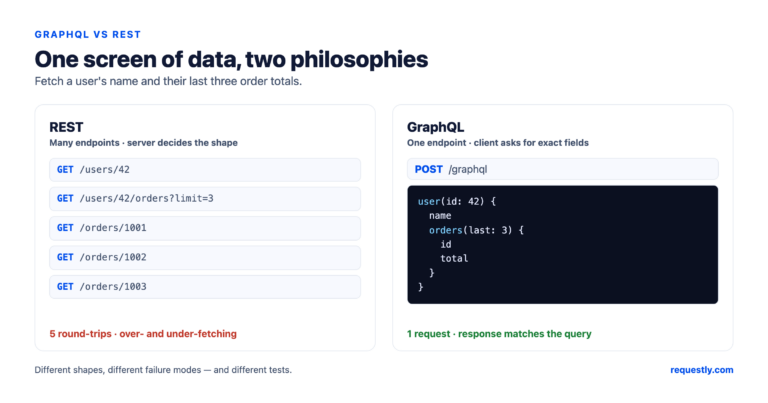
GraphQL solves client-driven data fetching and over-fetching for (often public) APIs; gRPC solves fast, strongly-typed service-to-service communication. They address different problems and can coexist.
Can I use gRPC for a public-facing API?
You can, but expect friction: browser support needs grpc-web, and third-party developers may struggle with tooling. A REST or grpc-gateway edge is usually friendlier for external consumers.
How do I test a gRPC API?
Use a gRPC-aware tool such as grpcurl or a client that supports Protocol Buffers, HTTP/2, and server reflection. For the REST parts of your system, an API client like Requestly works today.
Written by
Ronak Kadhi
Contents
- TL;DR
- What is REST?
- What is gRPC?
- gRPC vs REST: the differences that matter
- Data format and payload size
- Transport: HTTP/1.1 vs HTTP/2
- Contract and code generation
- Streaming
- Browser and ecosystem support
- At a glance
- When to use REST
- When to use gRPC
- You don't have to choose just one
- How to test REST and gRPC
- Testing REST
- Testing gRPC
- Final thoughts
- Frequently asked questions
- Is gRPC faster than REST?
- Can a browser call a gRPC service directly?
- Is REST being replaced by gRPC?
- What is the difference between gRPC and GraphQL?
- Can I use gRPC for a public-facing API?
- How do I test a gRPC API?
Subscribe for latest updates
[sibwp_form id=1]
Share this article
Related posts
Get started today
Join 300,000+ developers building smarter workflows.
Get Started for Free
Requestly Works on Desktop Only
Requestly isn’t available for download on mobile or tablets.
To download it, please open this page on a desktop PC and enter your email to get the link.
Mac app
Lightweight & Privacy-first API Client
- Local Projects
- Organize API into Collections & Environments
- API Tests
- Import from Postman, OpenAPI, etc
Download Now
Chrome extension
Intercept & modify HTTP requests/responses
- Redirect URLs & modify HTTP headers
- Mock API / GraphQL responses
- Insert custom JavaScript scripts
Add To Chrome