


The Best API Testing Tools in 2026: A Practical Guide by Category

Ronak Kadhi
June 11, 2026
10MIN READ
API testing isn’t one job, so there’s no single best tool. A by-category guide to the best API testing tools in 2026 – interactive clients, code frameworks, load testing, and contract testing – and how to choose.
Your lightweight Client for API debugging
No Login Required
Get Requestly
Requestly Works on Desktop Only
Requestly isn’t available for download on mobile or tablets.
To download it, please open this page on a desktop PC and enter your email to get the link.



Mac app
Lightweight & Privacy-first API Client
- Local Projects
- Organize API into Collections & Environments
- API Tests
- Import from Postman, OpenAPI, etc
Download Now


Chrome extension
Intercept & modify HTTP requests/responses
- Redirect URLs & modify HTTP headers
- Mock API / GraphQL responses
- Insert custom JavaScript scripts
Add To Chrome
Search for “the best API testing tool” and every list hands you a different winner. That’s because the question is malformed: API testing isn’t one job. Exploring an endpoint by hand, writing automated regression tests in your CI pipeline, proving an API survives 10,000 concurrent users, and guaranteeing two microservices don’t break each other’s contracts are four different problems — and no single tool is genuinely best at all of them.
So instead of ranking fourteen tools one through fourteen as if they competed for the same slot, this guide groups them by the job they actually do, tells you what each is good and bad at, and ends with a short decision guide so you can pick the right one (or, more realistically, the right two or three) for your stack.
The four categories that actually matter
Most API testing tools fall into one of four buckets:
- Interactive API clients — GUI tools to build, send, inspect, and script requests by hand. Where most testing starts (see our side-by-side API client comparison).
- Code-based testing frameworks — tests written in code that run in CI for automated regression.
- Load & performance tools — for measuring throughput, latency, and breaking points under traffic.
- Contract & enterprise tools — for preventing breaking changes between services, and for SOAP-heavy or regulated environments.
Pick the category first; the tool choice gets easy after that.
Category 1: Interactive API clients
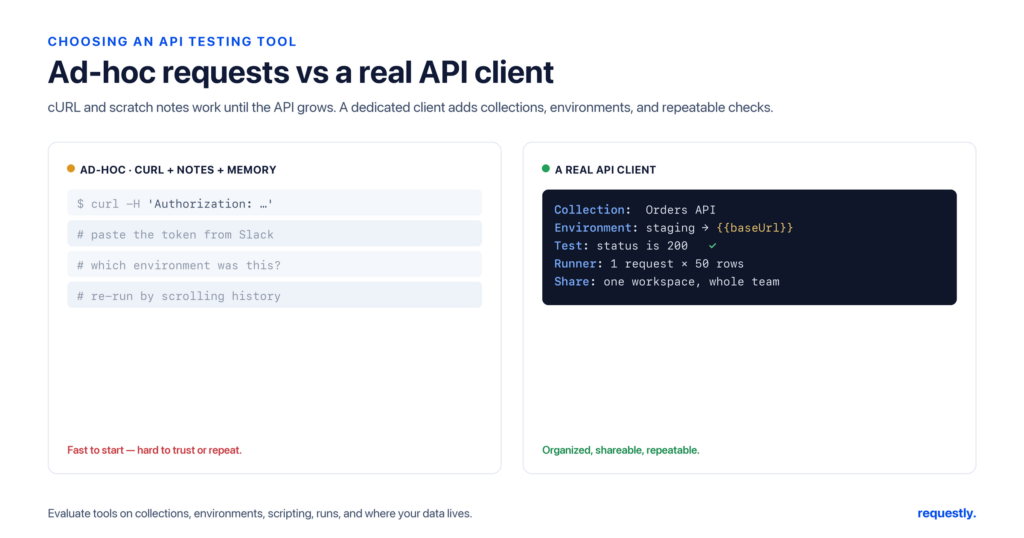
This is where almost everyone starts: a desktop or web app where you compose a request, send it, read the response, and add assertions. The good ones also do collections, environments, and scripting so manual exploration grows into a reusable test suite.
1. Requestly
Requestly is a privacy-first, local-first API client that’s free to use and doesn’t force you behind a cloud login to send your first request. It handles REST, GraphQL (with schema introspection), and SOAP; supports collections, environments, and every variable scope; and runs pre- and post-response scripts with Chai-style assertions (rq.expect) so checks live next to the request. A Collection Runner with CSV/JSON data files covers data-driven runs, and it imports from cURL, OpenAPI, Postman, HAR, and WSDL so you’re not starting from scratch. It can also generate client code from a request and draft tests with an AI assistant.
Honest scope: Requestly is built for interactive testing and in-client automation. For high-volume load testing or code-native pipelines, you’ll pair it with a tool from the later categories — which is normal, not a shortcoming.
Best for: developers who want a fast, local, privacy-respecting client without a mandatory account.
2. Postman
The market leader and the most feature-complete platform on this list: collections, mock servers, monitors, a CLI (Newman), Flows (a visual builder), and governance, plus deep collaboration. The trade-off is weight and gravity — it’s cloud-centric, generally expects an account, and the free tier caps things like collection runs, mock calls, and monitors. Your data lives in Postman’s cloud by default, which some teams can’t accept.
Best for: large teams that want an all-in-one platform and don’t mind the cloud dependency. If you’re looking specifically to move off it, see our guide to the best Postman alternative in 2026.
3. Insomnia
A clean, fast client (part of Kong) covering REST, GraphQL, gRPC, and WebSocket, with a plugin ecosystem and API-design features. A 2023 change that pushed users toward cloud login frustrated parts of the community — later softened with local and scratchpad modes — but it remains a strong, lean option, especially in Kong shops.
Best for: developers who want a lighter client than Postman with solid protocol coverage.
4. Bruno
Open-source and aggressively local-first: Bruno stores each request as a plain text file (its .bru format) right in your repo, so your API tests are versioned in Git alongside the code they test — no cloud, no account. It’s younger than the incumbents, with a smaller ecosystem and some features in a paid edition, but the Git-native model has won it a fast-growing following.
Best for: teams that want their API collection committed and reviewed like any other code.
5. Hoppscotch
A lightweight, open-source client that runs in the browser and can be self-hosted. It covers REST and GraphQL plus real-time protocols (WebSocket, SSE, MQTT), and it’s fast to reach for when you don’t want to install anything. It’s lighter on advanced test orchestration and large-team collaboration than the heavyweights.
Best for: quick, no-install testing and privacy-conscious self-hosted setups.
6. Apidog
An all-in-one tool that folds API design, testing, mocking, and documentation into a single Postman-like app. Convenient if you want the whole lifecycle in one place; like Postman it leans cloud-centric, and it’s a newer entrant still maturing.
Best for: teams that want design-to-test-to-docs without stitching tools together.
Testing inside a client, in practice
What separates a client from a glorified request sender is assertions. In Requestly, a post-response script turns a manual check into a repeatable test:
rq.test("status is 200 and body is correct", function () {
  rq.expect(rq.response.code).to.equal(200);
  const order = rq.response.json();
  rq.expect(order.status).to.equal("shipped");
});
Category 2: Code-based testing frameworks
When tests need to run on every commit without a human clicking Send, you move into code. These live in your repo and your CI pipeline.
7. REST Assured
A Java DSL that makes REST API assertions read almost like English, integrated with JUnit/TestNG and any JVM CI setup. It’s code-only and JVM-only, so it’s a natural fit for Java teams and an awkward one for everyone else.
given()
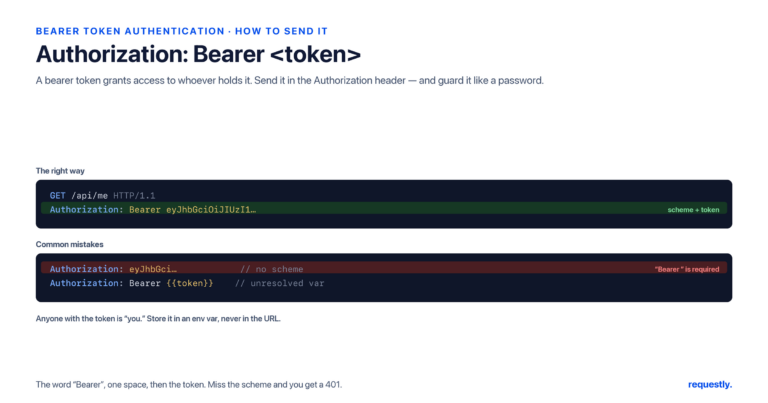
    .header("Authorization", "Bearer " + token)
.when()
    .get("/v1/orders/123")
.then()
    .statusCode(200)
    .body("status", equalTo("shipped"));
Best for: JVM teams embedding API regression tests in CI.
8. Karate
An open-source framework that writes API tests in a readable, Gherkin-style syntax with assertions built in — and can extend into UI and performance testing (via Gatling). You trade learning its DSL for tests that read like specs.
Best for: teams that want readable, spec-like tests without heavy programming.
9. Playwright
Best known for browser end-to-end testing, but its APIRequestContext makes it a capable API testing tool too — handy when you want to mix API setup and UI assertions in one CI suite. API testing is secondary to its browser focus, and it’s code-based.
Best for: teams already standardized on Playwright for E2E.
10. Schemathesis
A property-based tool that reads your OpenAPI schema (with experimental GraphQL support) and automatically generates test cases — including the edge cases you’d never think to write — to find spec violations and crashes. It’s CLI/code and schema-driven, so it complements hand-written scenarios rather than replacing them.
Best for: automatically catching contract violations and edge cases.
Category 3: Load & performance testing
Functional correctness says nothing about behavior under traffic. These tools answer “does it hold up?”
11. k6
A developer-centric load testing tool (part of Grafana) where you script scenarios in JavaScript and run them from the CLI or CI. It scales well and fits naturally into a code workflow — but it’s for performance, not manual exploration.
import http from "k6/http";
import { check } from "k6";

export const options = { vus: 50, duration: "30s" };

export default function () {
  const res = http.get("https://api.example.com/v1/orders/123");
  check(res, { "status is 200": (r) => r.status === 200 });
}
Best for: scripting performance and load tests in code.
12. Apache JMeter
The long-standing load testing workhorse: a GUI plus CLI, a deep plugin ecosystem, and protocol coverage well beyond HTTP. It’s heavyweight, its configs are XML, and the UI shows its age — but few tools match its breadth.
Best for: complex load tests and teams already invested in its ecosystem.
Category 4: Contract & enterprise tools
13. Pact
The standard for consumer-driven contract testing: it verifies that the expectations a consumer has of a provider stay satisfied, so independently deployed services don’t silently break each other. It’s a methodology to adopt rather than a client to open, with a corresponding learning curve.
Best for: microservice teams preventing breaking changes across service boundaries.
14. SoapUI / ReadyAPI
The SOAP-era standard from SmartBear. Open-source SoapUI is still a go-to for SOAP services, while commercial ReadyAPI layers on security and load testing. The UI is dated and ReadyAPI is priced for enterprises, but in SOAP-heavy or regulated environments it’s hard to avoid. (If your SOAP needs are lighter, a modern client like Requestly can import a WSDL and send SOAP envelopes too — see our SOAP vs REST guide.)
Best for: SOAP-heavy and enterprise/regulated environments.
The tools at a glance
| Tool | Category | Model | Best for |
|---|---|---|---|
| Requestly | Interactive client | Free, local-first | Privacy-respecting interactive testing |
| Postman | Interactive client | Free tier + paid, cloud | All-in-one platform for big teams |
| Insomnia | Interactive client | Free + paid | Lean client, multi-protocol |
| Bruno | Interactive client | Open source | Git-versioned collections |
| Hoppscotch | Interactive client | Open source, self-host | No-install / self-hosted testing |
| Apidog | Interactive client | Free tier + paid | Design-to-docs in one tool |
| REST Assured | Code framework | Open source (JVM) | Java teams in CI |
| Karate | Code framework | Open source | Readable, spec-style tests |
| Playwright | Code framework | Open source | API + UI in one CI suite |
| Schemathesis | Code framework | Open source | Schema-driven edge-case testing |
| k6 | Load / performance | AGPL OSS + cloud | Scripted load tests in JS |
| JMeter | Load / performance | Open source | Complex, broad-protocol load tests |
| Pact | Contract | Open source | Stopping breaking changes |
| SoapUI / ReadyAPI | Enterprise / SOAP | OSS + commercial | SOAP and regulated environments |
How to choose
- You want to explore and test APIs by hand, then script checks: an interactive client — Requestly, Postman, Insomnia, Bruno.
- You care about privacy and want free and local-first: Requestly, Bruno, or self-hosted Hoppscotch.
- You want your tests versioned in Git: Bruno’s file-based model, or export collections from your client of choice.
- You need automated tests in CI: REST Assured (JVM), Karate, Playwright, or Schemathesis for schema-driven coverage.
- You need to know it survives load: k6 for a code-first workflow, JMeter for breadth.
- You need to prevent services breaking each other: Pact.
- You’re SOAP-heavy or in a regulated enterprise: SoapUI / ReadyAPI — with a modern client for everyday REST/SOAP work.
Start with a client that respects your data: Requestly is a free, local-first API client for REST, GraphQL, and SOAP — with scripting, assertions, a collection runner, and imports from cURL, OpenAPI, Postman, and more. Explore the API client →
Final thoughts
There is no single best API testing tool, and any list that claims otherwise is hiding the question behind a ranking. A realistic 2026 stack is layered: an interactive client for daily work and exploration, a code framework for automated regression in CI, and a load tool for performance — with a contract tool added once you have services that can break each other. Choose the client layer for how it fits your workflow and your stance on privacy, then add the automation and load pieces as your needs grow.
Frequently asked questions
What is the best API testing tool in 2026?
There isn’t one, because API testing spans several different jobs. For interactive and scripted testing, an API client like Requestly, Postman, Insomnia, or Bruno is the right layer; for automated tests in CI, a code framework like REST Assured, Karate, or Playwright; and for load testing, k6 or JMeter. The “best” tool is the one that matches the specific job in front of you.
What is the difference between an API client and an API testing framework?
An API client is a GUI app where you build, send, inspect, and script requests interactively — ideal for exploration and manual testing that grows into reusable collections. A testing framework is code (REST Assured, Karate, Playwright) that runs in your CI pipeline for automated regression. Most teams use both: a client for daily work and a framework for unattended checks.
Are there free API testing tools?
Yes. Requestly is free and local-first, and Bruno and Hoppscotch are open source. Many code frameworks — REST Assured, Karate, Playwright, Schemathesis, k6’s core, and JMeter — are open source as well. Commercial platforms like Postman and ReadyAPI offer free tiers or trials with paid plans for advanced features.
Which API testing tool is best for privacy-conscious teams?
Look for local-first tools that don’t force cloud sync or an account. Requestly is privacy-first and stores your work locally, Bruno keeps everything in plain files in your repo, and Hoppscotch can be self-hosted. These avoid sending your requests, tokens, and responses to a third-party cloud by default.
Can one tool cover functional, load, and contract testing?
Rarely well. A few platforms advertise breadth, but in practice most teams combine specialized tools: an interactive client for functional testing, a load tool like k6 or JMeter for performance, and Pact for contract testing. Layering purpose-built tools beats stretching one tool past what it does well.
What is the best Postman alternative?
It depends on what pushed you away from Postman. For a free, privacy-first, local client, Requestly is a strong fit; for a lean multi-protocol client, Insomnia; for Git-native collections, Bruno. Our dedicated guide to the best Postman alternative in 2026 compares them in depth.
Written by
Ronak Kadhi
Contents
- The four categories that actually matter
- Category 1: Interactive API clients
- 1. Requestly
- 2. Postman
- 3. Insomnia
- 4. Bruno
- 5. Hoppscotch
- 6. Apidog
- Testing inside a client, in practice
- Category 2: Code-based testing frameworks
- 7. REST Assured
- 8. Karate
- 9. Playwright
- 10. Schemathesis
- Category 3: Load & performance testing
- 11. k6
- 12. Apache JMeter
- Category 4: Contract & enterprise tools
- 13. Pact
- 14. SoapUI / ReadyAPI
- The tools at a glance
- How to choose
- Final thoughts
- Frequently asked questions
- What is the best API testing tool in 2026?
- What is the difference between an API client and an API testing framework?
- Are there free API testing tools?
- Which API testing tool is best for privacy-conscious teams?
- Can one tool cover functional, load, and contract testing?
- What is the best Postman alternative?
Subscribe for latest updates
[sibwp_form id=1]
Share this article
Get started today
Join 300,000+ developers building smarter workflows.
Get Started for Free
Requestly Works on Desktop Only
Requestly isn’t available for download on mobile or tablets.
To download it, please open this page on a desktop PC and enter your email to get the link.
Mac app
Lightweight & Privacy-first API Client
- Local Projects
- Organize API into Collections & Environments
- API Tests
- Import from Postman, OpenAPI, etc
Download Now
Chrome extension
Intercept & modify HTTP requests/responses
- Redirect URLs & modify HTTP headers
- Mock API / GraphQL responses
- Insert custom JavaScript scripts
Add To Chrome