


A Beginner’s Guide to WCAG Testing Checklist

Parth Bhardwaj
March 18, 2026
9MIN READ
Master web accessibility with our beginner’s guide to the WCAG testing checklist, ensuring your site is inclusive for all users.
Your lightweight Client for API debugging
No Login Required
Get Requestly
Requestly Works on Desktop Only
Requestly is a web proxy that requires a desktop and desktop browser.
Enter your email below to receive the download link. Give it a try next time you’re on your PC!


Chrome extension
Instant & lightweight. Run the Requestly right inside your browser. Design, test, and mock APIs with collections, environments, and scripts.
Add To Chrome


Mac app
Local-first and more powerful. Use the Requestly on your desktop to design, test, and mock APIs across web, mobile, and desktop apps.
Download For Mac
Web accessibility ensures that users, including those with disabilities, can access, navigate, and interact with web content effectively. Ensuring compliance with accessibility standards such as the Web Content Accessibility Guidelines (WCAG) is vital in creating inclusive websites. These guidelines are structured to improve accessibility for all, including people with various disabilities. They ensure they are usable for individuals with different needs.
This article delves into the key principles of WCAG testing, provides a detailed checklist, outlines the success criteria for WCAG 2.0 and 2.1, explores popular WCAG testing tools, and discusses common accessibility failures and fixes.
WCAG Testing Principles
The WCAG guidelines are built around four core principles designed to help developers create content that is accessible to all users. These principles ensure that content is not only usable by people with disabilities but also provides an equitable user experience.
1. Perceivable
This principle focuses on ensuring that information and user interface components are presented in a way that all users can perceive. The primary goal is to make content available in multiple formats for different sensory modalities.
For example, non-text content like images should have descriptive text alternatives (alt text) so that screen reader users can access the information. Additionally, content must be presented in a way that users with visual impairments can interact with it, such as providing captions for video content.
2. Operable
The operable principle emphasizes that user interface components and navigation must be functional and accessible to everyone, including those who rely on assistive technologies.
This involves ensuring that all elements, such as links, buttons, and forms, are operable through a keyboard alone. Further, websites should avoid design patterns that trap users, such as overly complicated navigation or time-limited content that cannot be paused or extended.
3. Understandable
Content must be easy to understand and operate. This principle focuses on creating content that users can process and interact with. It includes simplifying language, providing clear instructions, and ensuring that navigation is predictable.
For instance, forms should have clearly labeled fields and provide easy-to-understand error messages when a user makes a mistake.
4. Robust
The robust principle ensures that content is compatible with a variety of user agents, including browsers, assistive technologies, and devices.
This means that websites should be built using standard HTML and CSS practices to ensure maximum compatibility with current and future technologies. It ensures that content works effectively across different platforms, devices, and assistive technologies like screen readers.
WCAG Testing Checklist
A comprehensive WCAG testing checklist is essential for verifying accessibility. This checklist ensures that all critical aspects of web accessibility are tested, helping developers create more accessible websites.
1. Text Alternatives
- Verify that all non-text content (images, icons, charts, videos) has appropriate alt text or other textual alternatives.
- Ensure that alt text conveys meaningful information about the image or content.
2. Color Contrast
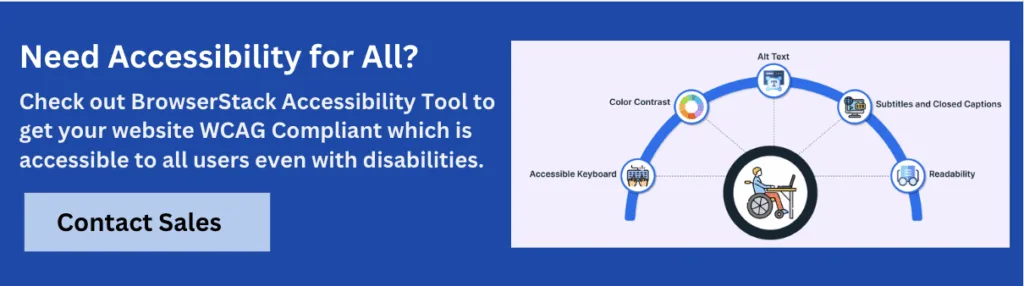
- Test the contrast ratio between text and background to ensure it meets the minimum required ratio of 4.5:1 for normal text and 3:1 for large text.
- Use tools like the Color Contrast Analyzer to check color contrast compliance.
3. Keyboard Accessibility
- Ensure that all interactive elements are navigable using the keyboard alone.
- Test for proper tab order, allowing users to easily navigate through the content and controls using only keyboard commands.
4. Clear Layout and Consistency
- Verify that the website’s layout is consistent across pages, with a predictable structure and navigation.
- Ensure that headings, paragraphs, and other elements are logically ordered for screen readers and keyboard navigation.
5. Resizable and Zoomable Content
- Test that users can resize text without loss of functionality or layout issues.
- Check whether the site layout adapts well to zooming in, ensuring that it remains usable even when magnified.
6. Accessible Forms
- Ensure that all form elements have clearly labeled fields and that labels are correctly associated with form inputs.
- Validate that error messages are helpful, specific, and provided in real-time during form submission.
7. Timed Content
- Verify that users are given enough time to read and interact with time-limited content.
- Provide options for users to pause, stop, or adjust the timing for such content when necessary.
8. Mobile Accessibility
- Test the website on mobile devices to ensure it is fully accessible and responsive.
- Ensure that touch targets are appropriately sized for ease of use and that the layout adapts well to different screen sizes.
Advantages of following a WCAG Testing Checklist
A WCAG testing checklist offers several advantages for developers and users:
- Better User Experience: Ensures websites are accessible to people with disabilities, improving overall usability.
- Wider Audience Reach: Increases website accessibility, attracting more users, including those with disabilities.
- Legal Compliance: Helps meet legal requirements like ADA and avoids potential fines.
- SEO Boost: Accessibility improvements often align with SEO best practices, boosting search rankings.
- Enhanced Brand Image: Shows commitment to inclusivity, improving customer loyalty and reputation.
- Cost Savings: Detects accessibility issues early, preventing expensive fixes later.
- Competitive Edge: Provides a distinct advantage over competitors by prioritizing inclusivity.
Success Criteria for WCAG 2.0 and 2.1
WCAG 2.0 and 2.1 provide specific success criteria, categorized under three conformance levels: A, AA, and AAA. These criteria define the minimum requirements that web content must meet to ensure accessibility.
WCAG 2.0 Success Criteria
Some of the most important success criteria from WCAG 2.0 include:
- Success Criterion 1.1.1: All non-text content must have a text alternative, such as alt text for images or a transcript for videos.
- Success Criterion 2.1.1: Make all content accessible by keyboard only, allowing users to navigate and interact with the site using the keyboard.
- Success Criterion 3.3.2: Forms should provide clear error messages and suggestions for corrections when users submit incorrect information.
WCAG 2.1 Success Criteria
WCAG 2.1 builds on WCAG 2.0, adding new criteria to address the needs of people with cognitive and learning disabilities, as well as those using mobile devices.
- Success Criterion 2.5.5: Ensure that touch targets, such as buttons and links, are large enough to be activated easily on touch devices.
- Success Criterion 3.2.4: Offer clear instructions and reduce the cognitive load on users, ensuring the website is easy to navigate and use.
WCAG Testing Tools
Several tools are available to automate WCAG testing and assist in evaluating the accessibility of websites. These tools help detect WCAG violations and offer recommendations for improvements.
1. BrowserStack Accessibility
BrowserStack Accessibility is a cloud-based tool that facilitates accessibility testing across real devices and browsers. It ensures WCAG (2.0, 2.1, 2.2) compliance and supports different conformance levels (A, AA, AAA). By simulating user interactions with assistive technologies, it provides a real-world testing experience for your websites and applications, ensuring that accessibility is maintained across platforms and devices.
Key Features:
- Tests WCAG 2.0, 2.1, and 2.2 conformance across various conformance levels (A, AA, AAA).
- Simulates real-user interactions with assistive technologies like screen readers and voice control.
- Provides cross-platform accessibility testing on multiple devices (real mobile and desktop devices).
2. Lighthouse
Lighthouse is an open-source, automated tool developed by Google that performs audits for accessibility, performance, SEO, and more. It is particularly useful for identifying WCAG compliance issues. Lighthouse generates detailed reports on accessibility concerns such as color contrast, keyboard navigation, and mobile-specific accessibility issues, making it easier to optimize web content for all users.
Key Features:
- Conducts automated WCAG audits, focusing on accessibility issues.
- Evaluates mobile accessibility for a better user experience across devices.
- Generates accessibility scores and detailed insights to guide improvements.
3. JAWS Screen Reader
JAWS (Job Access With Speech) is one of the most popular screen readers, providing essential feedback for users with visual impairments. It is widely used for testing how well websites and applications interact with screen reader technology. JAWS helps developers ensure that all web content is accessible to individuals relying on assistive technology.
Key Features:
- Tests website compatibility with screen readers, ensuring accessibility for users with visual impairments.
- Provides feedback on how well web content is communicated to screen reader users.
- Helps optimize web applications for accessibility to the visually impaired.
4. Tenon
Tenon is an API-based accessibility testing tool that automates WCAG conformance testing. It gives real-time feedback on accessibility issues, along with actionable solutions to fix them quickly. It is designed to integrate into development workflows, making it easy for developers to correct issues in real time.
Key Features:
- Provides automated accessibility testing for WCAG conformance.
- Delivers real-time feedback with specific solutions to resolve issues.
- Offers API-based integration, allowing seamless incorporation into development processes.
5. HTML_CodeSniffer
HTML_CodeSniffer is a JavaScript-based tool that analyzes HTML code to detect WCAG violations. It provides immediate, real-time feedback and highlights areas where code doesn’t comply with accessibility standards. This tool is particularly useful for quickly identifying accessibility issues during development.
Key Features:
- JavaScript-based tool that works directly within modern browsers.
- Provides real-time feedback on HTML code to identify WCAG violations.
- Highlights areas of the code that need improvement to meet accessibility standards.
6. SortSite
SortSite is an easy-to-use accessibility testing tool that performs comprehensive checks for WCAG compliance and usability issues. It tests websites across multiple browsers and generates reports that offer actionable suggestions for improving accessibility, ensuring that your site is accessible to all users.
Key Features:
- Comprehensive WCAG checks that test for accessibility across different conformance levels.
- Supports cross-browser compatibility testing.
- Generates actionable reports that help prioritize accessibility improvements.
7. Accessibility Insights
Accessibility Insights is an open-source tool from Microsoft designed to identify accessibility issues during both development and testing phases. It combines automated testing with manual checks and provides detailed, step-by-step guidance for fixing accessibility violations. It is also integrated with CI/CD pipelines for continuous accessibility testing.
Key Features:
- Performs both automated and manual accessibility checks to identify a wide range of issues.
- Offers step-by-step guidance to help developers fix violations.
- Integrates with CI/CD pipelines for continuous accessibility testing.
Common WCAG Failures and Fixes
Despite best efforts, web accessibility issues are common. Identifying and addressing these issues is crucial to improving the overall accessibility of a website.
1. Missing Alt Text for Images
- Failure: Images and other non-text content lack descriptive alt text.
- Fix: Ensure every image has meaningful alt text describing its content or function. Decorative images should have empty alt text (alt=””).
2. Insufficient Color Contrast
- Failure: Low contrast between text and background, making content hard to read for users with visual impairments.
- Fix: Use tools like the Color Contrast Analyzer to check and adjust the contrast ratio to at least 4.5:1 for normal text.
3. Keyboard Navigation Issues
- Failure: Interactive elements are not navigable via keyboard, making the site unusable for users with motor impairments.
- Fix: Ensure that all interactive elements are focusable and navigable using the Tab key and other keyboard shortcuts.
4. Inaccessible Forms
- Failure: Forms lack clear labels and instructions, making it difficult for users to complete them.
- Fix: Add descriptive labels to form elements and provide clear instructions and error messages.
5. Lack of Clear Error Messages
- Failure: Forms and other interactions don’t provide helpful error messages when users make mistakes.
- Fix: Provide detailed and specific error messages that explain what went wrong and how to correct it.
Conclusion
By following the WCAG guidelines and using the right tools, developers can create inclusive and usable websites for all users. With testing tools such as BrowserStack Accessibility, Lighthouse, and JAWS, etc developers can ensure that their websites meet accessibility standards across a variety of devices and assistive technologies.
Properly addressing accessibility issues can significantly enhance the user experience, ensuring that digital content is accessible to all, regardless of their abilities.
Written by
Parth Bhardwaj
Contents
- WCAG Testing Principles
- 1. Perceivable
- 2. Operable
- 3. Understandable
- 4. Robust
- WCAG Testing Checklist
- Advantages of following a WCAG Testing Checklist
- Success Criteria for WCAG 2.0 and 2.1
- WCAG Testing Tools
- 1. BrowserStack Accessibility
- 2. Lighthouse
- 3. JAWS Screen Reader
- 4. Tenon
- 5. HTML_CodeSniffer
- 6. SortSite
- 7. Accessibility Insights
- Common WCAG Failures and Fixes
- Conclusion
Subscribe for latest updates
Share this article
Related posts



Get started today
Join 300,000+ developers building smarter workflows.
Get Started for Free
Requestly Works on Desktop Only
Requestly is a web proxy that requires a desktop and desktop browser.
Enter your email below to receive the download link. Give it a try next time you’re on your PC!
Chrome extension
Instant & lightweight. Run the Requestly right inside your browser. Design, test, and mock APIs with collections, environments, and scripts.
Add To Chrome
Mac app
Local-first and more powerful. Use the Requestly on your desktop to design, test, and mock APIs across web, mobile, and desktop apps.
Download For Mac