





Get Requestly
Captions make video content accessible, searchable, and user-friendly across platforms. They’re essential for engaging diverse audiences in today’s digital-first world.
Why is video captioning important? Captions support users with hearing impairments and improve comprehension in sound-off environments. They also enhance SEO and global reach.
What are the best practices for video captioning?
- Use correct grammar, punctuation, and spelling
- Sync captions precisely with audio
- Keep text concise and easy to read
- Include relevant non-speech sounds
- Test captions across devices and browsers
This article explores the most effective video captioning best practices, including accessibility standards, formatting guidelines, quality checks, and tools to help teams create compliant and inclusive video content.
Importance of Accurate Video Captioning
Accurate video captioning is critical for making digital content accessible, understandable, and compliant. Poorly timed or incorrect captions can mislead viewers, especially those relying on them due to hearing loss or language barriers.
Here’s why accuracy matters:
- Accessibility: Ensures equal access for users with hearing impairments.
- User Experience: Helps viewers in sound-off environments or noisy settings.
- Searchability: Accurate captions improve SEO through indexed text.
- Legal Compliance: Many regions mandate high-quality captions to meet accessibility laws.
- Professionalism: Clean, precise captions reflect positively on your brand.
Inaccurate captions not only reduce comprehension but can also lead to compliance violations and user drop-off.
Difference Between Captions, Subtitles, And Transcripts
Understanding the differences between captions, subtitles, and transcripts helps determine the right format for your content strategy.
| Type | Purpose | Includes Audio Cues | Display Style | Use Case |
| Captions | Accessibility for hearing impairments | Yes | Timed on-screen text | Required for compliance |
| Subtitles | Translation for viewers who can hear | No | Timed on-screen text | Multilingual content |
| Transcripts | Full text of spoken content | No | Static text document | SEO, archives, content indexing |
- Captions include sound effects and speaker identification.
- Subtitles are used for translating speech in other languages.
- Transcripts offer a readable version of dialogue, often for reference or SEO.
Choosing the right format depends on your goals, such as accessibility, global reach, or content documentation.
Top Video Captioning Standards You Should Follow
To ensure accessibility and avoid legal risk, captions must align with recognized standards. These guidelines outline the appearance, functionality, and support of captions for all users.
Key Standards:
1. WCAG (Web Content Accessibility Guidelines)
- Requires captions for prerecorded audio content.
- Focuses on synchronicity, accuracy, and visibility.
- WCAG 2.1 and 2.2 are widely adopted by global accessibility laws.
2. ADA (Americans with Disabilities Act)
- Mandates captioned video for businesses, schools, and public services.
- Focuses on equal access to digital content.
3. Section 508 (U.S. Federal): Requires federal agencies to provide captioned multimedia content.
4. AODA (Accessibility for Ontarians with Disabilities Act): Enforces captioning on public websites and digital platforms in Ontario.
These standards ensure captions are usable, understandable, and legally compliant, making them essential for any content strategy focused on accessibility.
Best Practices for Writing Accurate Video Captions
Follow these best practices to ensure your captions are clear, accurate, and accessible:
- Use correct spelling, grammar, and punctuation to maintain clarity and professionalism.
- Transcribe speech verbatim unless editing is needed for readability or pacing.
- Include non-speech sounds like [music] or [laughter] only when contextually relevant.
- Clearly identify speakers using names, descriptors, or hyphens for dialogue changes.
- Limit captions to two lines to improve readability and avoid screen clutter.
- Maintain consistent terminology, style, and formatting throughout the video.
- Avoid slang and expand uncommon abbreviations for wider understanding.
- Break lines at logical pauses or phrase boundaries to support smooth reading.
- Time captions to sync precisely with spoken audio.
- Ensure captions remain on screen long enough for viewers to read comfortably.
- Remove captions quickly after the corresponding speech ends.
- Use plain, simple language to support viewers with cognitive disabilities.
- Localize captions for regional spelling, terminology, and cultural context.
- Proofread and test captions across browsers and devices before publishing.
Styling and Formatting Best Practices for Captions
Caption styling impacts readability and accessibility. Consistent formatting ensures captions are user-friendly across platforms.
Apply the following formatting practices:
- Limit to Two Lines per Frame: Helps maintain legibility and prevents crowding.
- Use Sans-Serif Fonts: Choose accessible fonts like Arial or Helvetica in a readable size.
- Maintain Consistent Positioning: Typically bottom-center; move only when visuals need to remain visible.
- Apply High Contrast: Use white text on a semi-transparent black background for visibility.
- Line Breaks at Logical Points: Break lines at natural phrase endings or punctuation, not mid-thought.
- Italicize Off-Screen Speech or Narration: Helps differentiate from on-screen dialogue.
These styling rules improve user experience and help meet accessibility requirements such as WCAG and ADA.
Video Caption Timing and Synchronization Tips
Even well-written captions can fall short if they’re out of sync. Proper timing enhances comprehension and avoids user frustration.
Best practices for syncing captions with video:
- Match Timing to Speech: Display text when the words are spoken, and remove it when the speech ends.
- Avoid Overlapping Captions: Show one caption at a time to prevent confusion.
- Adjust Duration for Reading Speed: Each caption should remain onscreen long enough to be read comfortably, typically 1.5 to 6 seconds.
- Don’t Delay or Pre-Display: Syncing should feel natural, not rushed or early.
- Use Frame-Accurate Timing: Fine-tune to the video’s frame rate for seamless playback.
Testing across real browsers and devices helps catch sync issues early and ensures a smooth viewing experience.
Captioning Tools and Software for High-Quality Video Captions
Choosing the right captioning tool improves speed, accuracy, and consistency. Whether manual or AI-powered, the best tools support multiple formats and accessibility features.
Popular tools for high-quality captioning:
- Descript: Combines audio/video editing with automatic transcription and caption export.
- Amara: Cloud-based captioning with collaborative editing and multilingual support.
- Rev: Offers both human-generated and AI-powered captioning with high accuracy.
- YouTube Studio: Built-in automatic captions with manual adjustment capabilities.
- Veed.io: Online editor with easy timeline-based caption creation and styling.
- Kapwing: Provides auto-captioning, editing, and support for common formats like SRT and VTT.
Tip: Look for tools that allow previewing captions across layouts and exporting in compliant formats to meet WCAG and ADA standards.
How to Ensure Caption Accuracy and Quality Control
Accurate captions are critical for accessibility, comprehension, and compliance. Quality control should combine human review with automated testing to ensure captions meet standards across devices and user scenarios.
Key steps for maintaining caption quality:
- Watch the full video to manually verify sync, grammar, line breaks, and speaker labels.
- Check that non-speech sounds are correctly labeled (e.g., [music], [laughter]).
- Validate readability by limiting captions to two lines and avoiding fast-scrolling text.
- Test across browsers and devices to ensure captions are responsive and unobtrusive.
- Use automated tools to identify issues like overlapping captions, contrast failures, or display errors.
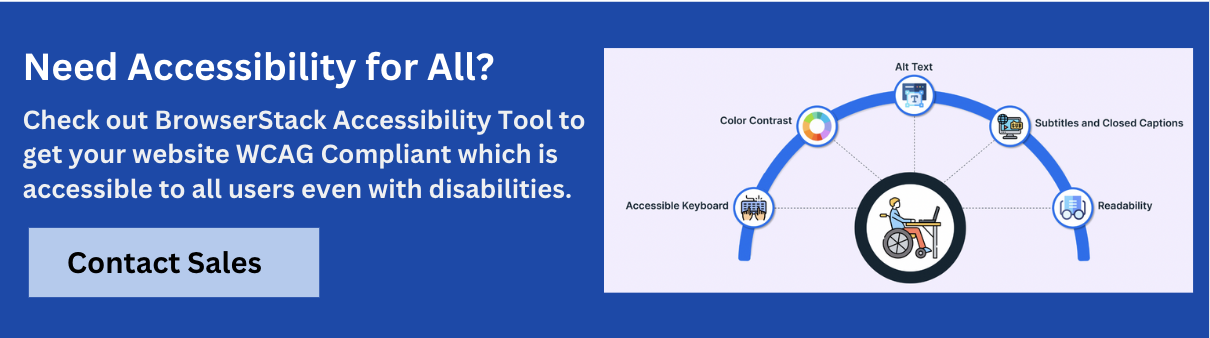
To simplify and scale this process, teams can use BrowserStack Accessibility Testing, which offers free automated scans for WCAG compliance. It detects issues affecting caption visibility, such as low contrast backgrounds or layout conflicts, and supports screen reader testing on real devices.
With unlimited scans and support for up to five pages per test, it’s ideal for verifying video accessibility across workflows.
Legal Requirements and Accessibility Compliance for Captions
Captions are required by law in many regions and are central to digital accessibility compliance. Whether publishing educational, enterprise, or public-facing content, legal standards demand captions that are accurate, synced, and accessible.
Key regulations to follow:
- WCAG 2.1 / 2.2: Requires synchronized captions for all prerecorded video with audio.
- ADA (U.S.): Obligates public and private organizations to provide accessible video content.
- Section 508: Federal agencies must ensure electronic content—including video—is fully accessible.
- AODA (Canada): Mandates captioning for web content in Ontario.
- Equality Act (UK) & DDA (Australia): Require inclusive digital content via captioning aligned with WCAG.
Best Practices for Captioning in Multilingual and Global Content
Creating captions for global audiences requires more than translation; it demands cultural sensitivity and consistency.
Follow these best practices for multilingual captioning:
- Use Native-Speaking Translators: Ensure accurate, culturally relevant translations.
- Avoid Direct Translation of Idioms: Adapt phrases for regional understanding.
- Sync Translated Captions With Localized Audio: Match timing to new voiceovers or subtitles.
- Maintain Formatting Consistency: Use the same style, punctuation, and line limits across languages.
- Support Multiple Languages in Video Players: Let users select their preferred caption language.
Multilingual captioning expands reach, improves inclusivity, and supports compliance across diverse markets.
Conclusion
High-quality video captions are essential for accessibility, compliance, and user engagement. By following captioning best practices, teams can deliver content that’s inclusive, professional, and legally sound.
From manual reviews to automated testing, every step matters. Tools like BrowserStack Accessibility Testing ensure your captions work across browsers, devices, and assistive technologies, helping you create video experiences that reach everyone.

Get Started for Free