





Get Requestly
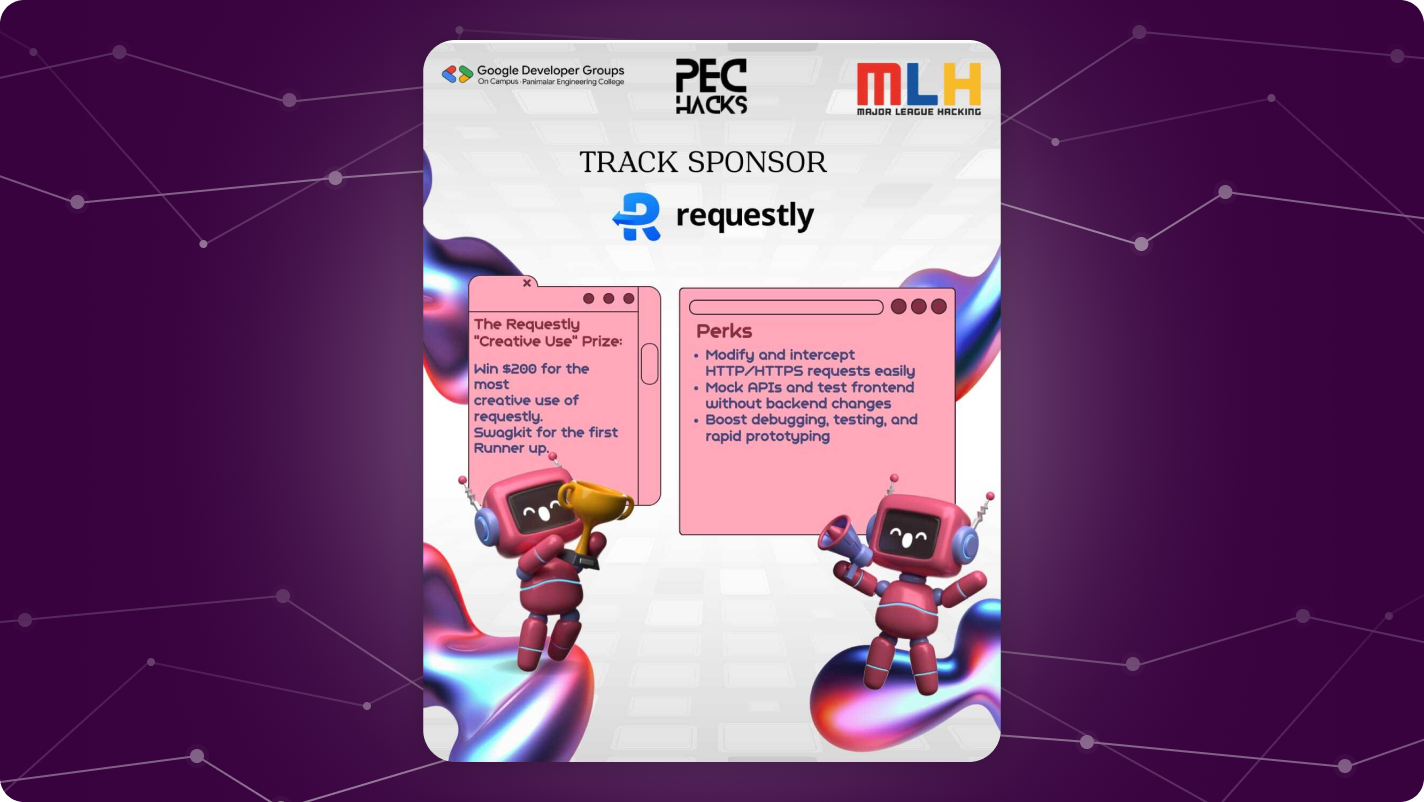
At Requestly, we recently hit an exciting milestone: sponsoring our first-ever hackathon track! We headed to Chennai for Panimalar Engineering College (PEC) Hacks 3.0, a massive 36-hour event that brought together over 500 hackers and resulted in 100+ innovative projects.
It was an honor for Requestly to be part of such a high-caliber event, standing alongside industry leaders like Google Gemini, Cloudflare, and DigitalOcean. Our challenge to the participants was simple: show us the “Hacker Mindset.” We didn’t just want a cool app; we wanted to see how developers could use Requestly to solve complex problems, save time, and “bend the web to their will.”
The energy was electric, and these two teams truly showed us what the next generation of developers is capable of.
The Winner: MetalliSense
The Inspiration: In industrial settings, analyzing metal composition (spectrometry) usually requires massive, expensive setups. The team built MetalliSense to make this process smarter and more distributed by using AI to analyze spectrometer data in real-time across different locations.
The Tech: This was a true engineering feat. Instead of building one simple app, the team created a distributed system spread across three different laptops and the AWS cloud.
How they used Requestly: MetalliSense didn’t just use Requestly for minor fixes; they used it as the “integration backbone” for their entire network.
- Microservice Testing: They used Requestly to ensure their Node.js and Python services were communicating perfectly across separate physical machines before the frontend was even built.
- Cloud Validation: When moving to AWS, they used Requestly to verify that their “AI Agents” were routing data correctly between different cloud environments.
- Network Accuracy: They treated Requestly as a mission-critical tool to validate API schemas and network-level interactions, ensuring the system was production-ready.
Meet the Team:
Chat with the Winners: Team MetalliSense
What was the inspiration for your project? The inspiration came from an industry visit where we saw how alloy corrections in foundries are still manual and reactive. Small mistakes lead to huge energy waste and scrap. We wanted to build a system that analyzes live spectrometer data and recommends precise alloy additions in real time to reduce waste.
What made you choose Requestly for your project? Our system used a microservice architecture with services running on different machines. Tools like Postman were too limiting because they only support isolated testing. Requestly allowed us to intercept and mock HTTP requests in real time without changing our backend code. It was perfect for validating our AI integration.
What was your favorite part about using Requestly? The ability to debug the entire backend workflow live without depending on a frontend. We could mock AI responses and simulate failure scenarios—like timeouts or invalid data—to see how our system handled them. It gave us better visibility into how all our services interacted as a complete system.
What resources did you use to learn Requestly? We primarily used the official Requestly documentation. It helped us quickly understand the core features, and most of our learning happened hands-on while we were actually building and experimenting during the hackathon.
What was the most challenging part of the project? Ensuring stable communication between our servers and the AI models, especially when services failed independently. Requestly helped us overcome this by letting us isolate and validate each interaction, making our live demonstration much more reliable.
Runner-Up: Disha Ecosystem
The Inspiration: AI tools can be life-changing for education, but they are often too expensive for students to build with. Team Disha wanted to create a multilingual learning platform powered by five different AI services without going broke during the development phase.
How Requestly saved them:
- 85% Cost Savings: By using Requestly’s API Mocking, they simulated responses from expensive voice APIs like ElevenLabs. This allowed them to test their app thousands of times without paying for every single call.
- Debugging “X-Ray Vision”: They hit tricky bugs where different languages (like Tamil and English) were mixing incorrectly. Requestly let them “see” exactly what the APIs were returning so they could fix the logic instantly.
- Resilience Testing: They used Requestly to block their internet connection on purpose, making sure the app’s “Offline Mode” handled errors gracefully.
Meet the Team:
What’s Next?
Our time at Panimalar Engineering College showed us that Requestly is much more than a API platform, it is an essential building block for building complex, reliable, and cost-effective software.
We are excited to announce that we are sponsoring more hackathons in the coming weeks and months!
Are you organizing a hackathon? We’d love to support your community and see what your hackers can build. Feel free to reach out to us!




Get Started for Free