


Get Requestly
A thorough accessibility audit helps you uncover usability issues that might exclude users with disabilities.
This guide breaks down the process into clear, actionable steps so you can make your digital content compliant and user-friendly.
What is an Accessibility Audit?
An accessibility audit is a structured evaluation of a digital product, such as a website, application, or document, to determine how well it supports users with disabilities.
The audit assesses whether the product meets recognized accessibility standards, primarily the Web Content Accessibility Guidelines (WCAG).
It includes both automated checks and manual testing to identify barriers that affect people using assistive technologies like screen readers, keyboard navigation, or voice input.
The goal is to uncover issues related to navigation, interaction, readability, and compliance that may prevent equitable access.
Importance of an Accessibility Audit
An accessibility audit ensures that digital content is inclusive, user-friendly, and legally compliant.
By identifying and addressing accessibility barriers, teams can improve user experience for everyone.
Why accessibility audits are essential:
- Legal compliance: Helps meet requirements under laws like the ADA, AODA, and Section 508
- Inclusive user experience: Ensures access for users with visual, auditory, cognitive, and motor impairments
- Improved usability: Many accessibility features benefit all users, such as clear navigation and readable text
- Brand reputation and trust: Demonstrates a commitment to digital inclusion and responsible design
- Risk reduction: Proactively identifies issues that could lead to legal action or customer complaints
Auditing is a critical part of delivering accessible digital products at scale.
When Should You Run an Accessibility Audit
Accessibility audits should be performed regularly and strategically throughout the product lifecycle. Waiting until the end of development increases the cost and effort required to fix issues.
Key moments to conduct an accessibility audit include:
- Before a major launch or redesign to ensure all new content is accessible from the start
- During QA cycles as part of sprint reviews or release testing
- After significant code or content changes that may introduce new accessibility barriers
- As part of compliance checks for legal, procurement, or third-party certification
- On a recurring schedule to maintain accessibility over time and monitor regressions
Integrating audits into your ongoing development and testing workflow leads to better accessibility outcomes and reduces last-minute rework.
Accessibility Standards to Audit Against
To ensure digital accessibility and compliance, audits must be aligned with globally recognized standards. These guidelines define how websites and applications should support users with disabilities across various platforms and use cases.
The most widely used accessibility standards include:
- WCAG 2.1 and 2.2 (Web Content Accessibility Guidelines): Developed by the W3C, WCAG outlines success criteria across four key principles: perceivable, operable, understandable, and robust. Version 2.1 added mobile and low vision support, while 2.2 introduces improvements for users with cognitive and motor disabilities. Most organizations aim for Level AA compliance.
- ADA (Americans with Disabilities Act): In the United States, the ADA requires businesses and public services to provide accessible digital content. Web and mobile properties are expected to meet WCAG standards as part of this requirement.
- Section 508 (United States Federal Law): All federal agencies and contractors must ensure their digital content meets WCAG 2.0 Level AA or higher.
- AODA (Accessibility for Ontarians with Disabilities Act): Organizations operating in Ontario, Canada, are required to comply with WCAG 2.0 Level AA for digital accessibility.
- EN 301 549 (European Union): This standard is based on WCAG 2.1 and applies to all public sector digital services in EU member states.
Auditing against these standards ensures accessibility compliance across regions and improves usability for all users.
How to Do an Accessibility Audit: Step-by-Step Process
Conducting an accessibility audit requires a structured approach. Following a clear step-by-step process helps teams uncover critical issues, prioritize fixes, and deliver an inclusive user experience.
Step 1: Define the Scope of the Audit Identify which parts of the website or application will be audited. This may include high-traffic pages, templates, forms, media content, or key user journeys.
Step 2: Select the Audit Standards and Success Criteria Decide which accessibility standards to follow, typically WCAG 2.1 or 2.2 Level AA. Consider any additional regional or industry-specific requirements.
Step 3: Choose Tools and Assistive Technologies Use a combination of automated tools (e.g., BrowserStack, axe, Lighthouse) and assistive tech like screen readers, switch devices, or voice control systems to test functionality.
Step 4: Run Automated Accessibility Scans Perform automated scans to detect structural issues such as missing alt text, low contrast, improper heading order, and ARIA misuse.
Step 5: Conduct Manual Testing Manually review user interactions such as navigation, form inputs, modal dialogs, and dynamic content. Validate keyboard access, visual focus, and screen reader output.
Step 6: Test with Assistive Technologies Use tools like VoiceOver, TalkBack, and keyboard navigation to simulate real user behavior. Check that users can complete key tasks without barriers.
Step 7: Document Issues and Rate Severity Record each issue with a description, affected element, recommended fix, and severity rating (e.g., high, medium, low).
Step 8: Review Code and Semantic Structure Inspect HTML structure, ARIA roles, and landmark usage to ensure the application follows semantic best practices.
Step 9: Share Findings With Stakeholders Present the audit results with clear visuals, grouped issues, and remediation plans that are easy for design, dev, and QA teams to act on.
Step 10: Plan for Fixes and Retesting Assign issue owners, fix accessibility barriers, and retest updated pages to confirm that each item is resolved properly.
This step-by-step approach provides a repeatable framework for conducting accessibility audits that lead to actionable improvements.
Tools for Accessibility Auditing
Accessibility audits are most effective when supported by reliable tools that help uncover a wide range of issues.
A combination of automated and manual testing tools ensures comprehensive coverage.
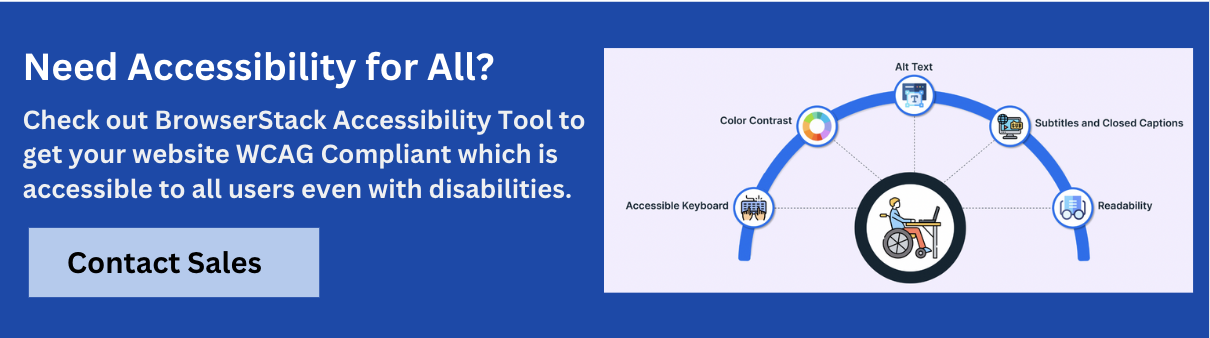
1. BrowserStack Accessibility Testing provides automated audits on real browsers and devices, making it ideal for web accessibility validation in realistic environments.
- Runs WCAG 2.0, 2.1, and 2.2 compliance checks across desktop and mobile browsers
- Detects key issues like missing labels, color contrast failures, and focus order problems
- Supports screen reader and keyboard navigation testing on real devices
- Allows cross-browser compatibility checks for accessibility-critical components
You can run free accessibility scans on BrowserStack for up to five unique pages per test.
2. axe DevTools is a developer-friendly browser extension that integrates seamlessly with testing workflows.
- Offers in-browser WCAG testing with detailed, contextual issue explanations
- Supports integration into CI/CD pipelines for early-stage accessibility checks
- Provides fix recommendations directly in the browser’s DevTools panel
3. WAVE Evaluation Tool offers a quick way to detect and visualize accessibility issues directly on a live page.
- Highlights problems such as missing alt text, low contrast, and structural errors
- Visual overlays make it easy to connect issues with on-page elements
- Useful for designers and non-technical stakeholders reviewing accessibility
4. Google Lighthouse is a built-in audit tool in Chrome DevTools that offers baseline accessibility checks.
- Analyzes pages for common issues like missing labels, semantic HTML, and contrast errors
- Assigns accessibility scores to help prioritize improvements
- Offers actionable suggestions with links to documentation
5. NVDA and VoiceOver are screen readers used for manual testing of real-world accessibility experiences.
- Validate how content is announced to users with visual impairments
- Check focus behavior, navigation flow, and content structure interpretation
- Help uncover issues that automated tools may miss
Using a combination of these tools provides broader visibility across code, UI, and user experience layers is critical for a thorough accessibility audit.
How to Prioritize and Fix Accessibility Issues
Once issues are identified during an audit, the next step is to organize them based on user impact, severity, and development effort. Prioritization ensures the most critical barriers are addressed first and guides teams in managing remediation work effectively.
Steps to prioritize and resolve accessibility issues:
- Classify issues by severity such as high (blocks critical tasks), medium (affects usability with workarounds), and low (minor visual inconsistencies).
- Group issues by type and affected components: Organize issues into categories such as forms, navigation, media, and layout. This helps developers address related fixes in batches.
- Assign ownership and timelines: Distribute issues across development, design, or content teams. Set realistic deadlines based on release cycles.
- Document fixes and retest: After implementing changes, verify that issues are resolved using the same tools and assistive technologies used in the original audit.
- Track regressions in future builds: Integrate automated checks into CI pipelines to prevent reintroducing accessibility barriers.
Creating an Accessibility Audit Report
An audit report documents all identified accessibility issues, provides context, and guides remediation. A well-structured report ensures developers, designers, and stakeholders can take action effectively.
Key elements to include:
- A summary of findings, audit scope, and applicable standards
- A prioritized issue list with descriptions, screenshots, and affected components
- Recommended fixes with references to WCAG success criteria
- Status tracking for resolved and open issues
- Clear formatting for technical and non-technical audiences
Deliver the report in a format that can be easily reviewed, shared, and tracked across teams.
Maintaining Accessibility After the Audit
Accessibility is not a one-time task. Maintaining it requires ongoing effort across updates, new features, and content changes.
Best practices for long-term accessibility:
- Include accessibility checks in all future sprints and QA cycles
- Retest previously flagged components after updates
- Monitor regressions using automated tools and manual reviews
- Schedule periodic audits for large releases or redesigns
- Provide continuous training for dev, QA, and design teams
Sustained accessibility ensures your product stays compliant, usable, and inclusive over time.
Conclusion
An accessibility audit is essential for identifying and resolving barriers that impact users with disabilities. By aligning with standards like WCAG, using the right tools, and following a clear audit process, teams can improve usability, meet compliance requirements, and build inclusive digital products.
Integrating accessibility into workflows and maintaining it post-audit ensures long-term impact, not just short-term fixes. A well-executed audit helps organizations deliver better experiences for everyone.



Get Started for Free
Contact us